
 Locations







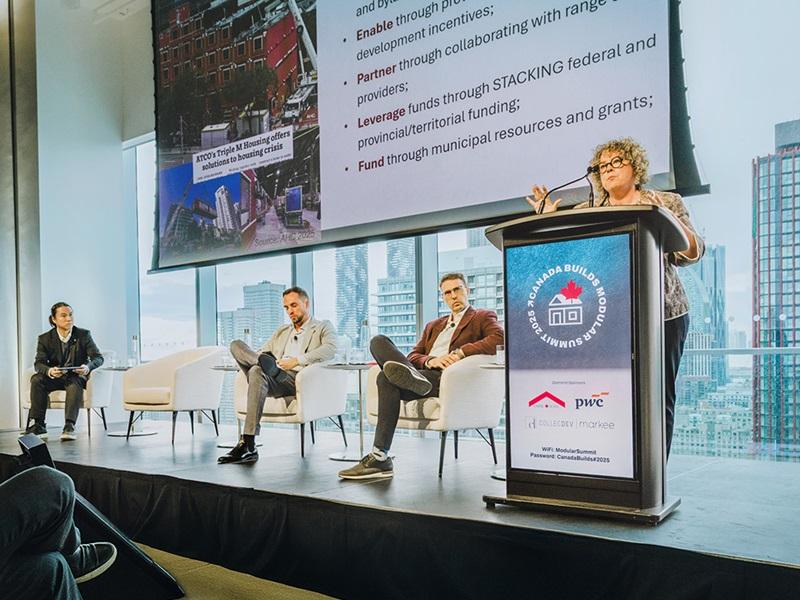
GUEST SUBMISSION: None of us would disagree that 2025 was a year of uncertainty and industry shifts, from condo to rental pivots to nation-building sentiments and affordability conversations becoming increasingly prominent.
This occurred not just in Toronto and Vancouver, but across Canada.
But as the pressure for how to deliver new housing more efficiently intensified, we also saw new voices and conversations emerge to help boost a challenged sector.
What really stood out for me was the momentum building around modular construction, and its potential to transform the way our industry designs and delivers multi-unit housing. Modular is a form of prefab construction where the bulk of project construction, like full kitchens, and rooms with flooring, windows and doors, are built in controlled factory environments.
Industry reports suggest modular projects can be completed 20 to 50 per cent faster compared to traditional construction timelines. Other benefits include lower labour requirements, less material waste, and more cost certainty, addressing both affordability and sustainability goals.
This new wave of attention was in part due to Build Canada Homes’ emphasis on prioritizing “modern methods of construction” (including prefabrication components, modular building, and mass timber) and the first-ever Canada Builds Modular Summit in Toronto in October. Organized by Collecdev-Markee, the summit brought together government, private sector developers, non-profits, planners, architects, lenders and manufacturers to explore how we can co-create the conditions in Canada to allow modular to be deployed at scale to accelerate housing supply.
Through each conversation you could really feel the potential and see the possibilities. The message was consistent: we need more housing, and while we are all rethinking how to meet that demand, modular could be that silver bullet.
But despite having the technology and expertise, there are many barriers preventing us from scaling.
As one of the guest speakers put it, we need modular to build the Canadian railroad of housing, but how do we clear the track?
Barriers holding us back
The largest barrier seems to be ourselves; the understanding of modular construction throughout the real estate ecosystem as well as public perceptions.
As Collecdev-Markee CEO Jennifer Keesmaat explains in a recent episode of Commercial Real Estate Podcast, the challenges aren’t the construction methods, technologies or know-how; it’s everything that surrounds this. Factory capacity, municipal zoning bylaws, site readiness, market demand and financing models all need to align.
To begin, municipal planning across the country is not set up to handle modular. In the podcast interview Keesmaat provided a window into some of zoning challenges like the need to include a garbage room in one of her modular projects, a space you could easily incorporate in a traditional high-rise building. But trying to fit modular designs in traditional construction typologies, she explained, simply does not work.
Similarly, delays in municipal approvals for modular projects can result in significant cost overruns for the developer if they need to hold their prefabricated modular volumes in a storage facility as they wait for the city’s green light to assemble on-site. Adding to this co-ordination challenge, manufacturers require developers to be ready to receive their prefabricated modular components once they are completed so production capacity does not get bottlenecked.
But change is starting to emerge.
At the summit, it was motivating to hear from City of Calgary’s chief planner and director of community planning, Dr. Teresa Goldstein, who is piloting changes to create better conditions and regulations to support modular outcomes. In her presentation she explained how the city is reversing parts of its approvals process by moving building permits and building form to the front end, before land use is finalized.
Manufacturers are also working to optimize their digital design processes to ensure they align with municipal building approvals and permit needs ahead of time, so everything can be approved before the modular components are factory-built.
Closing the financing gap
Developers who want to embrace modular, often find constraints in traditional construction financing, where milestones are based on site progress, foundation, framing or enclosure - basically, when materials are fixed to the site. For modular projects, since the majority of construction costs occur off-site, developers would need to finance the bulk of their project up front, long before conventional or CMHC financing becomes available, which is not always feasible.
To address this gap, Aaron Cameron, VP at First National Financial shared at the summit how his team worked with CMHC to help roll out a financing solution that can support off-site construction.
It introduced contract bonding, a formal agreement between the developer and the modular manufacturer backed by an assurance provider. This structure provides the certainty lenders need to treat factory production as an eligible construction cost.
Changing Canada’s modular housing story
We also heard manufacturers say they need more consistent demand to better plan and invest in growing their capacity. But to date, much of Canada’s investments in modular housing has been for low-income and shelter housing.
As a result, consumers associate modular housing with temporary shelter, a perception we will need to change if we want to increase market demand.
Other global cities offer a different narrative we can take inspiration from in areas such as Sweden, New York and Singapore. These areas are known for using prefabricated and modular construction methods ranging from single-family homes to luxury condos and large apartment buildings.
What’s next on the line?
This fall the federal government announced it will deliver 540 new multifamily units at Downsview Park in Toronto using modern methods of construction as part of Build Canada Homes.
This was welcome news for modular construction manufacturers, which may soon be able to scale-up production and give us more proof of concept for high-quality, multifamily builds. But there is still so much work to be done if we truly want to enjoy the benefits and the transformative change off-site, modular construction can bring to our industry and to our cities.
From financing to planning policies and consumer attitudes, how the modular story evolves in Canada’s challenged housing sector, is something I will certainly be watching closely in 2026.
If you are interested in going deeper on this topic, check out the Commercial Real Estate Podcast episode I referenced, Solving the Modular Puzzle. Or catch the recordings from the Canada Builds Modular Summit, in particular the panel, Supply Chain, Site Readiness and Delivery: Clearing the Path to Scale.





 Industry Events
 Locations